Skip to content

Get to know us

A drawer of takeaway chopsticks, and a problem nobody had solved.

Stick ’Em started on 16 September 2020 with a second-hand 3D printer, an Arduino board off Taobao, and the observation that most of the world’s classrooms were being told STEAM mattered and given nothing to teach it with.

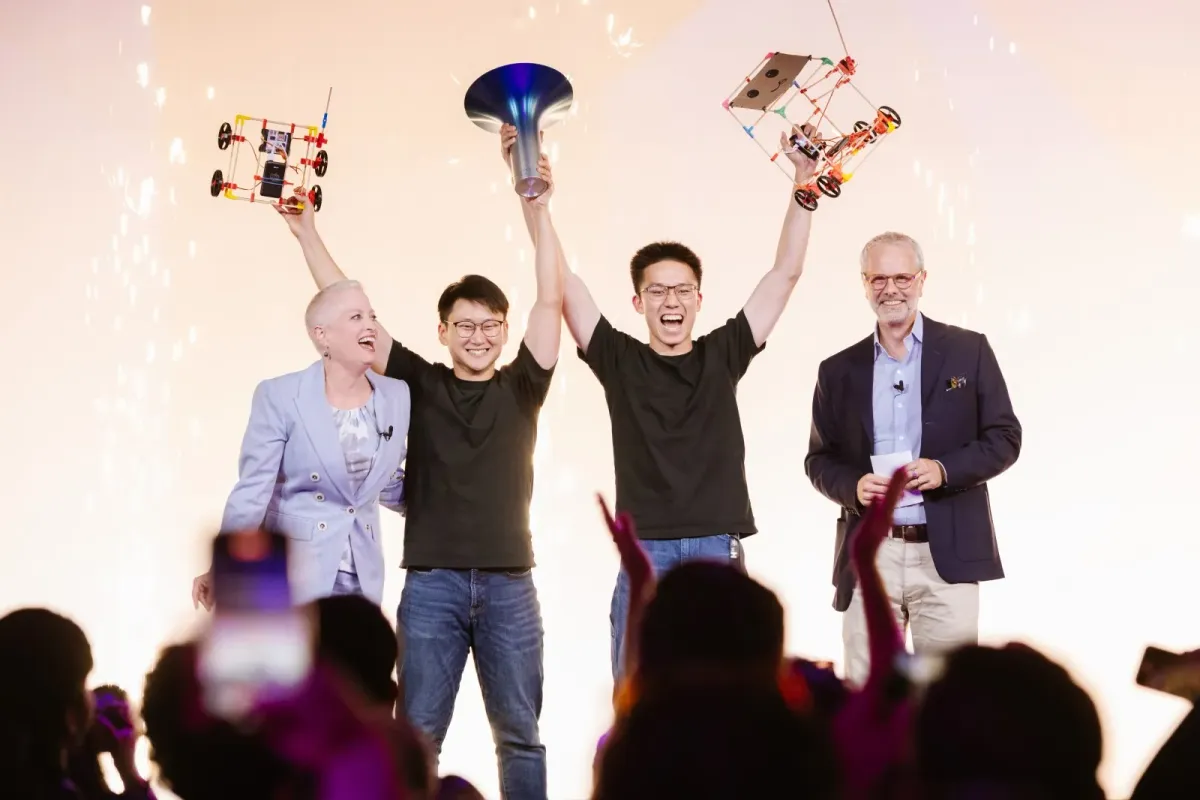
The Stick ’Em founders on the Hult Prize 2025 stage, holding the trophy and two chopstick builds above their headsHult Prize global finals, Tate Modern, London, 2025

Where we are now

Five years in

35,000+students have used it
3800+teachers trained
22countries
2020founded, on 16 September

A social enterprise registered in Singapore, based at BLOCK71 at one-north.

Our story

Behind the fireworks and glory are 5 years of blood, sweat and tears.

Kai wrote this after the Hult Prize win. It is his telling, not a rewrite of it.

Why we started

We grew up as builders, tinkerers and innovators. From robots to air cannons to flamethrowers, we spent our childhoods building all sorts of crazy things.

Growing up in the Singapore education system, we always had access to well funded public schools with great teachers and resources.

After graduating from secondary school, we quickly realised that the current ways STEAM education is being taught were not really developing future problem solvers. Instead, it was producing students who only knew how to copy code and replicate robot designs, a far cry from what STEAM was supposed to develop.

Furthermore, quality STEAM education was not accessible to 90% of the world. How can we expect a school in developing regions, struggling with funding and manpower to integrate hands-on learning and robotics into their curriculum? Or a family worrying about basic necessities afford to send their child to a premium coding class to “get ahead”?

There was a growing divide between the haves and have-nots, and while the world preached STEAM and 21st Century skills as future skills needed, classrooms around the world were still stuck in the past. Everyone knew this was an issue, but no one had the solution to this.

On September 16 2020, we created Stick ’Em to solve that.
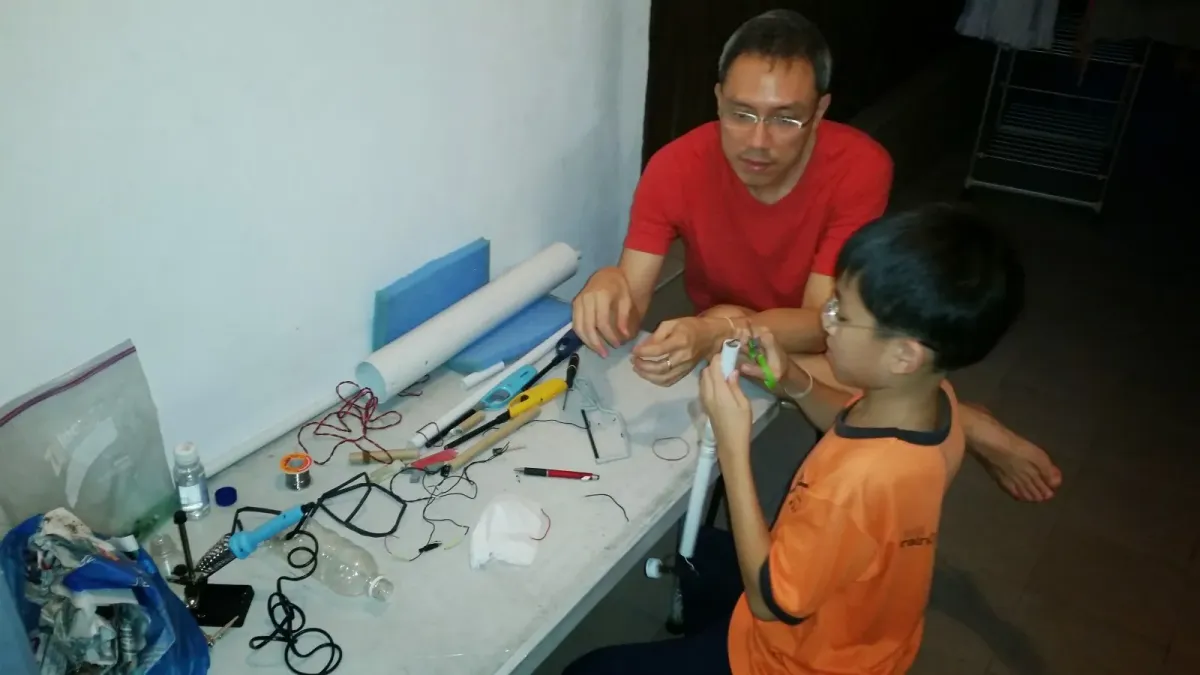
Kai as a schoolboy at a workbench, assembling a PVC air cannon out of pipe, tape and wire while an adult helps

Why chopsticks

The idea was deceptively simple. Chopsticks, geometric connectors, and plug and play electronics. The basic building blocks required for students to create prototypes and learn concepts through play.

Tinkering is messy. It’s spontaneous, crazy, creative, and unconventional. We didn’t want kids to be worried about cutting things or damaging expensive parts, so we kept the process of using Stick ’Em as DIY as possible.

Armed with takeaway chopsticks from hawker stalls, a 2nd hand 3D printer and an off-the-shelf Arduino from Taobao, we put together a minimum viable product that had basic controls.

We tested the first kit with friends and family’s kids. It worked pretty well, and we continued to refine it over a few months, adding more connector variations and upgrading the electronics until it got closer and closer to a polished looking STEAM kit.

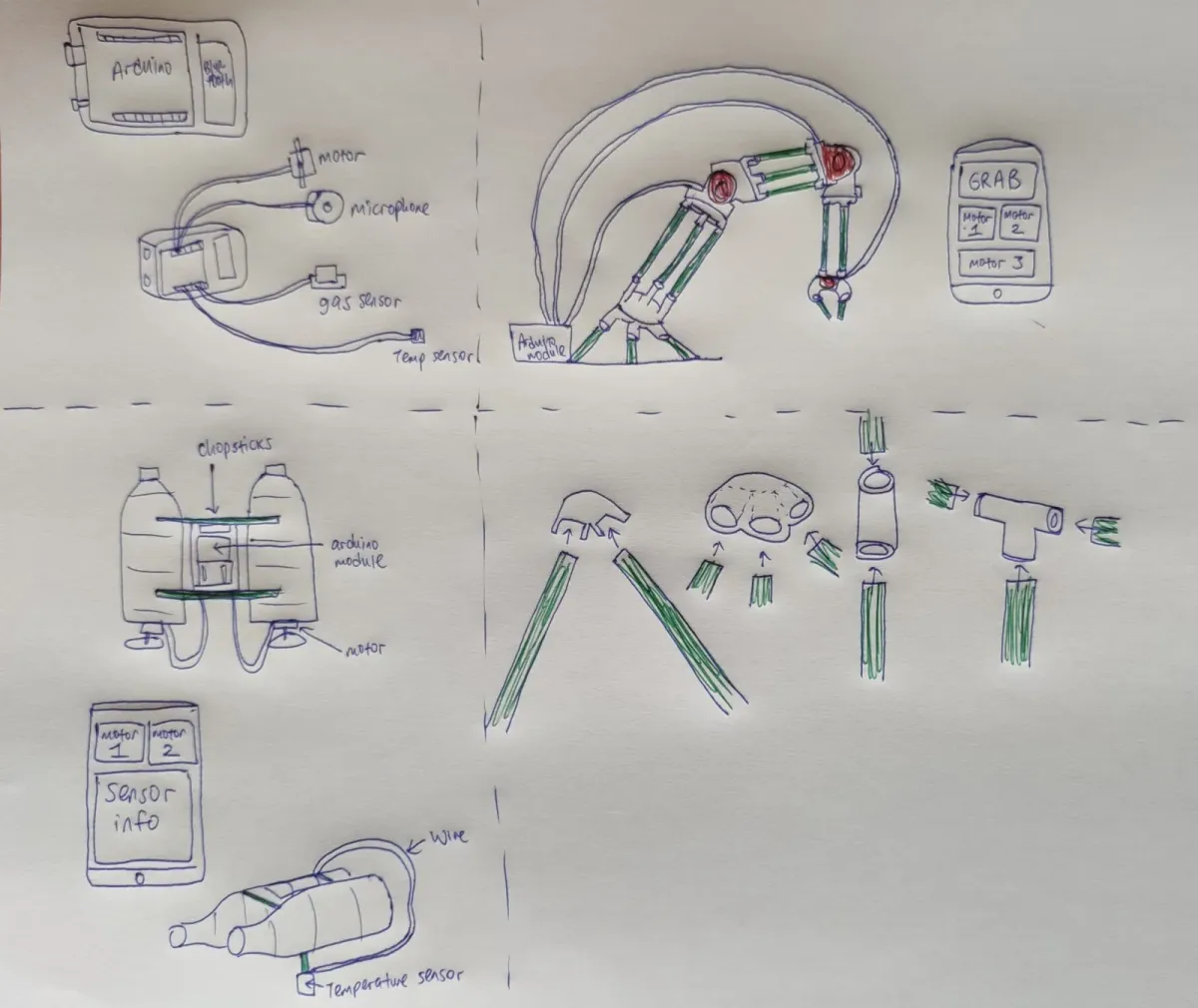
Two pages of the original hand-drawn Stick ’Em sketches: chopstick limbs, geometric connectors and early mechanisms

The first breakthrough

Then, our first breakthrough came. We won our first hackathon, the RHBHacks 2021 organised by Mapletree. We couldn’t believe it.

$7500 cash prize, getting featured on the Straits Times, and we were given a temporary stall at the River Hongbao festival to share about Stick ’Em.

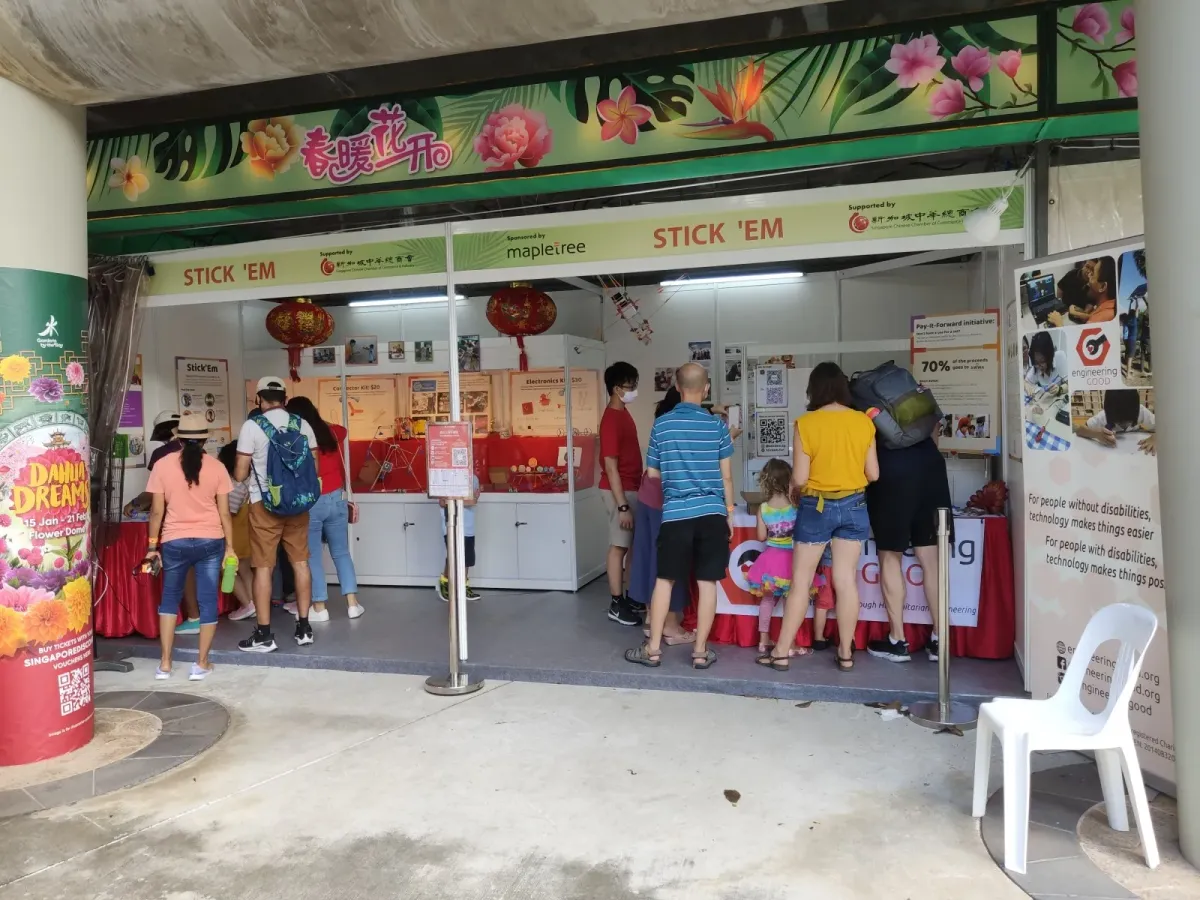
Over the course of 3 days, hundreds of families visited our booth, learning about Stick ’Em and placing pre-orders for our robotics kit. We had 160+ orders, and looking back, it was crazy seeing such overwhelming support for our scrappy, half developed kit that did not even have that many features yet.

The Stick ’Em booth at the River Hongbao festival, families crowded along the counter trying the kits

Then reality hit

We quickly realised that we now had to produce every single kit manually, with no production line.

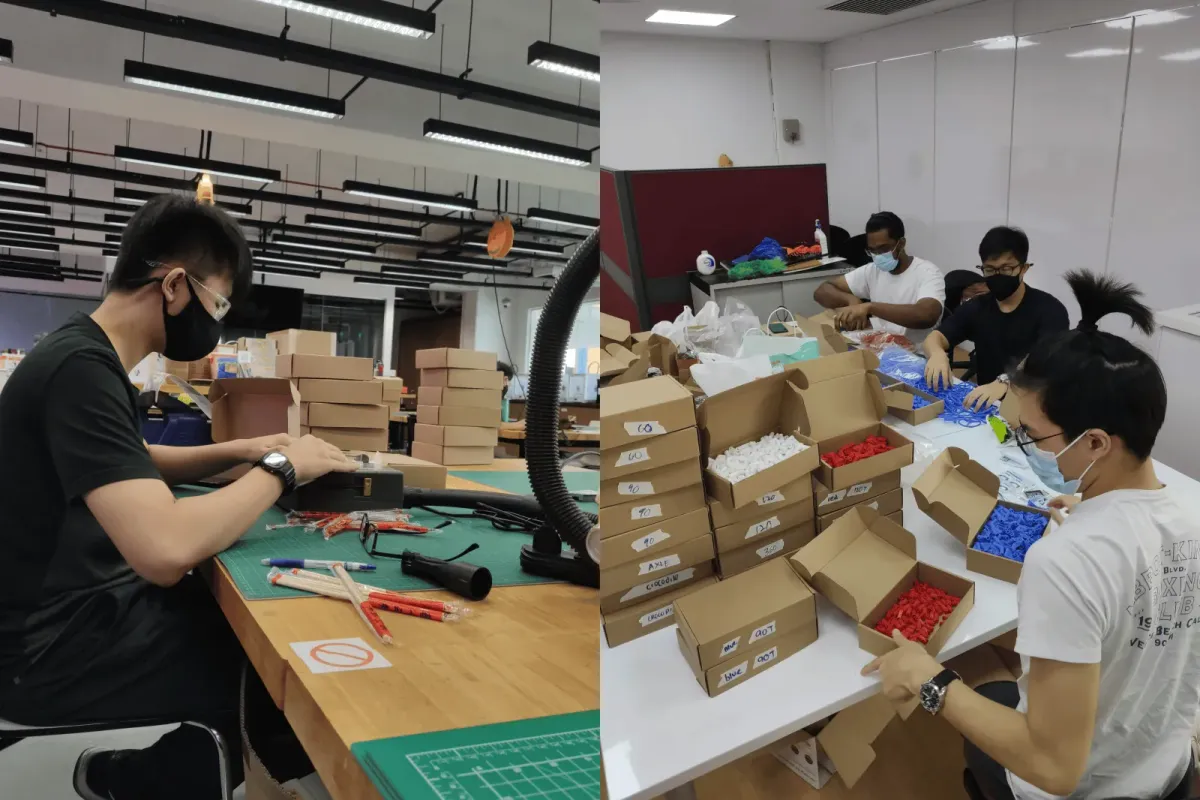
We were manually unwrapping and cutting chopsticks one at a time, with a mini bandsaw. Looking back, this was incredibly dangerous and we were lucky to still have all 10 fingers after finishing these 160+ orders.

For the 3D printed connectors, we were running multiple 3D printers at a time in Singapore Polytechnic’s FabLab. We got classmates, friends and family to help with the massive task of sorting and packing, and somehow managed to fulfil every order in time.

Early production by hand: one person cutting chopsticks at a workbench, three people filling boxes on the floor

Out into the world

As we gained more traction in schools, we also received more grant funding from the National Youth Council, Philip Yeo Initiative, SUTD’s Create4Good, and a few other places. Our team and office expanded steadily to handle the increasing demand.

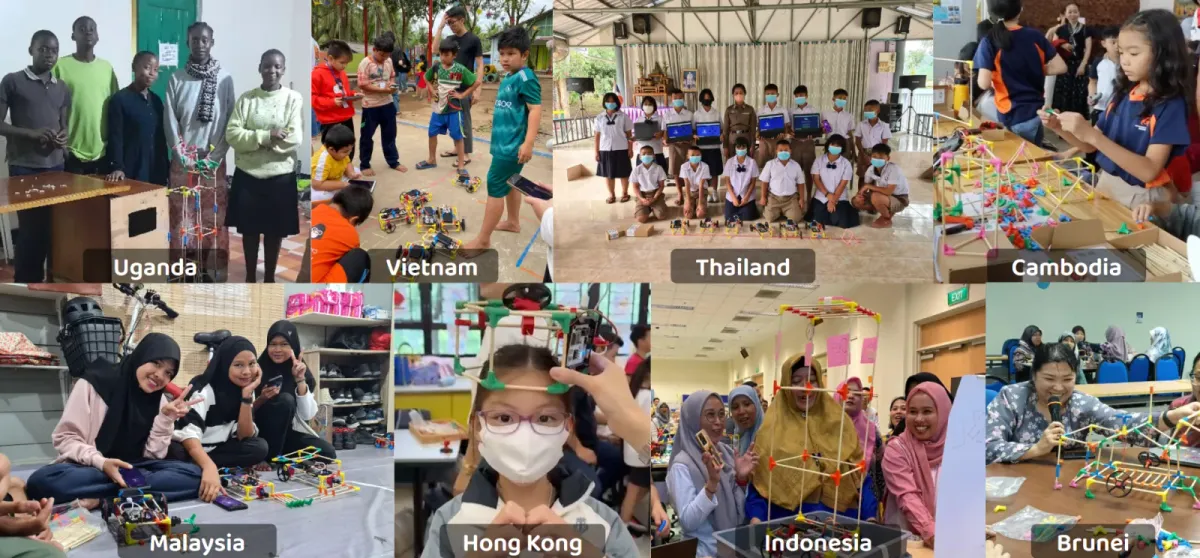
We started to expand overseas, seeing how Stick ’Em was able to serve all sorts of schools with different backgrounds. From top schools in Singapore to rural schools in Uganda, every student that used Stick ’Em was creating innovative solutions.

Teachers were texting us about how they saw improvements in their students learnings, and were actually excited to come to class to use Stick ’Em.

At the same time throughout these 5 years running Stick ’Em as a fast growing startup, some of us were doing our diplomas, university, and even mandatory military service. It was a constant balance of schooling and Stick ’Em, but both taught us valuable lessons and we always managed to make it work.

Eight classroom photographs from Uganda, Vietnam, Thailand, Cambodia, Malaysia, Hong Kong and Singapore

The Hult Prize

We decided to join the Hult Prize 2025 for a shot at the $1 Million USD prize to scale up our impact. We were up against 15,000 teams from 133 different countries, all presenting their world changing ideas.

After the online incubator, it got narrowed down to 24 teams, who would spend 1 month at the Ashridge House in the Global Accelerator sharpening their ideas with mentors in real life. In Week 3, we pitched at Google’s London HQ and miraculously made it into the 8 finalist teams.

Although our script was constantly changing, right up till the night before, our mission and real world impact was clear. We just had to tell the Stick ’Em story in an authentic way. We presented in our usual light hearted, youthful manner, and showed everyone how a team of youth had spent almost a quarter of their lives tackling the massive problem of inequality in STEAM education.

We delivered our best pitch ever at the finals. Everyone in the room could feel our passion and commitment to the mission, and one of the judges even went “WE LOVE THEM” during the Q&A.

And then, the announcement came. The winner of the Hult Prize 2025 was Stick ’Em.

What Kai wrote down that week, September 2025
  • Impacted 20,000+ students
  • Trained 2000+ teachers in STEAM
  • Scaled to 200+ schools across 15 countries
Today
  • 35,000+ students
  • 3800+ teachers trained
  • 22 countries
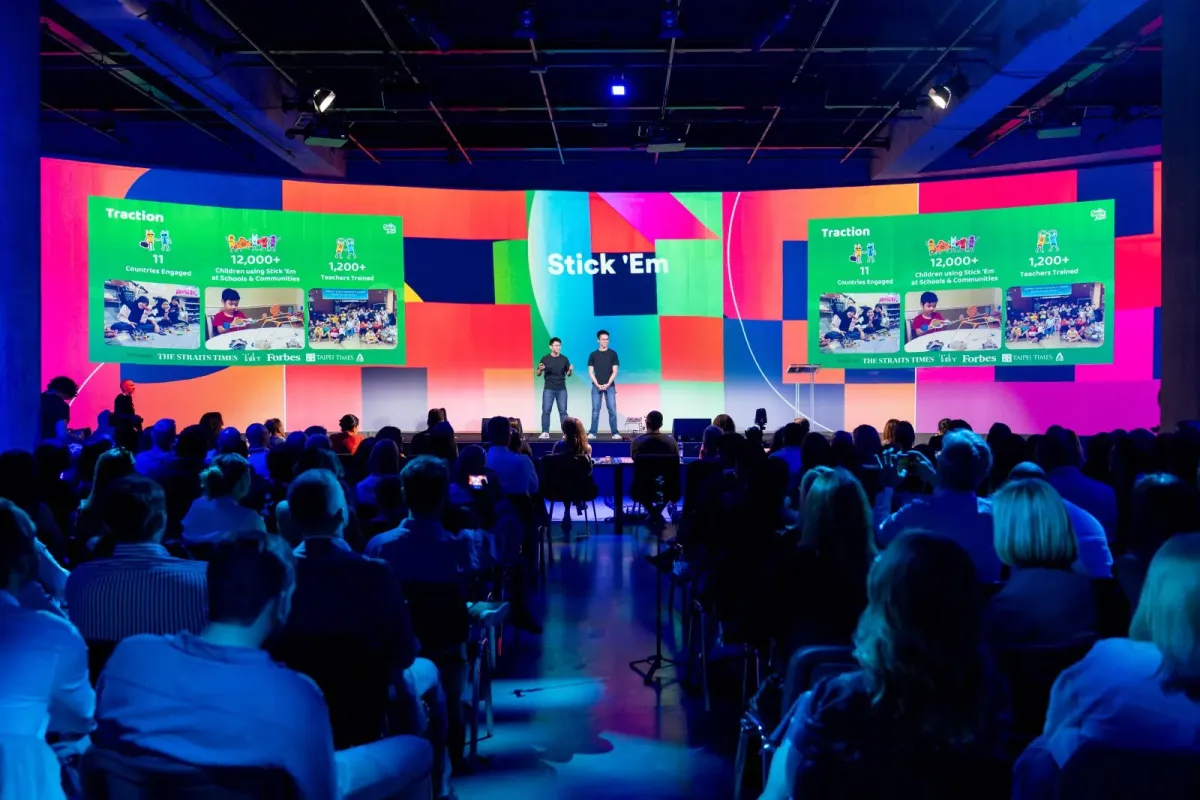
The Hult Prize global finals stage, the Stick ’Em traction slide filling the LED wall behind the team

What’s next

This message goes out to anyone out there looking to make a change in the world. No matter how crazy your idea might seem, keep pushing for what you believe in.

Because 5 years ago, a group of young, naive teens decided to build chopstick robots, with the crazy idea of making STEAM education accessible to all. Today, they are standing on this global stage with the ability to scale their impact to millions of children out there.

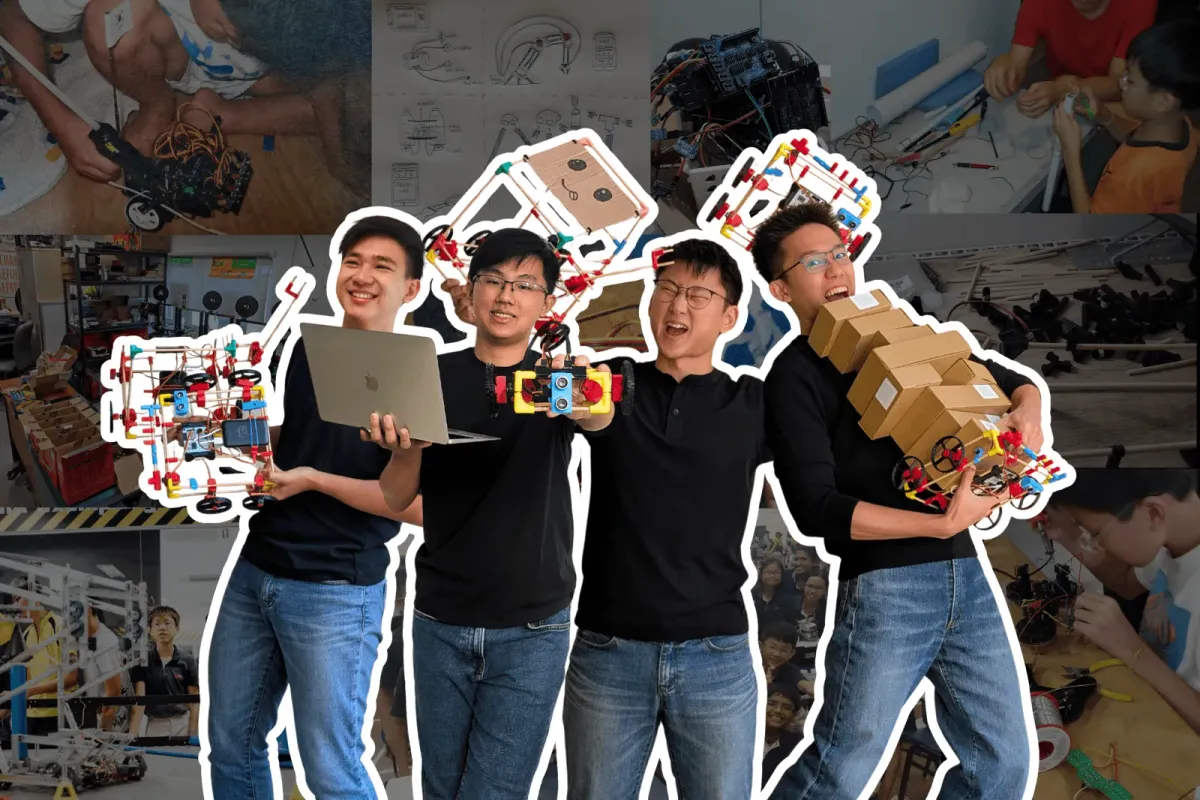
The four founders standing together holding builds and a laptop, over a collage of classrooms

The team

Fourteen people, and most of them were students when they started.

Stick ’Em is a social enterprise registered in Singapore. These are the people whose names are on the emails you will get back.

Chong Ing Kai

Chong Ing Kai

Founder and CEO

Kai founded Stick ’Em in September 2020, at seventeen, with a drawer of takeaway chopsticks, a second-hand 3D printer and an Arduino board ordered from Taobao.

He had been building things since he was seven, mostly things his parents would rather he had not: air cannons, tasers, a flamethrower in the backyard. School went less well. He has ADHD and still holds his school’s record for most suspensions. What turned it around was a Singapore charity called Engineering Good, which showed him that the same restlessness could be pointed at a problem.

At sixteen, working in the STEAM industry, he saw how much of hands-on education was reserved for schools that could afford it. Stick ’Em is the answer he has been building ever since.

In 2025 Stick ’Em won the Hult Prize ($1M USD) at the global finals at Tate Modern in London, the first Singapore team to do so. Kai was named to the Forbes 30 Under 30 Asia list the same year. He is a Philip Yeo Initiative Fellow, a Sigma Squared Society Fellow and a YSEALI Academic Fellow.

Adam Huh DamCo-founder and Executive Director

Leads strategy and growth, and was named alongside Kai on the Forbes 30 Under 30 Asia list in 2025. An Impact VC Innovation Fellow in 2020.

Tew Jing AnSoftware and Electronics

Builds the software and electronics behind the kit, from the control board to the Academy platform teachers use every day.

Chong Kai JieDigital Product Design

Shapes how Stick ’Em looks and feels, across the kit, the apps and everything a teacher picks up.

AVAakash V RamanBusiness Development

Works with schools, distributors and partners, and has run Stick ’Em programmes from Singapore to Pasadena.

JJainOperations and Logistics

Runs operations, which is how a Classroom Set ordered in Singapore reaches a school in Sabah or Kampala.

Plus the people who pack, print, teach and answer email, several of whom are still finishing their own studies while they do it.

If the mission resonates with you.

We are looking for schools, for partners in new markets, and for people who want to help make this ordinary rather than remarkable.