Governments and ministries
A STEAM programme a ministry can actually afford to run everywhere.
One kit serves forty students and lasts two to three years. One three-hour workshop makes an ordinary teacher self-sufficient, and able to train the colleague next door. That is what makes this work in the schools that get left out of national rollouts.
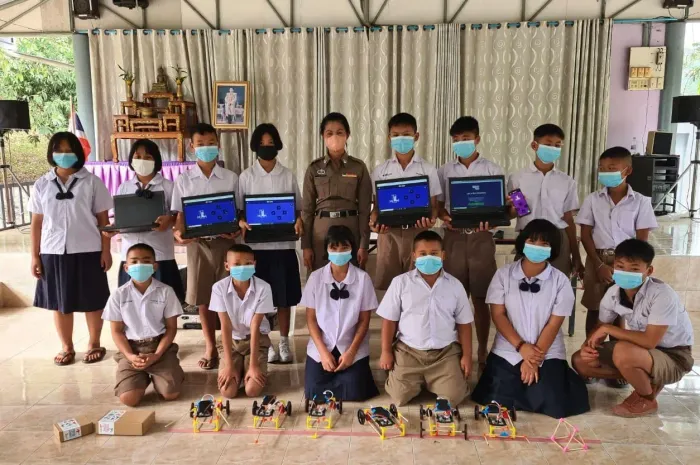 A border school, Thailand
The argument, in three numbers
Why this scales where other STEAM programmes do not.
per student, per year
One Classroom Set covers forty students and lasts two to three years. In the Brunei national costing that came to roughly two dollars per student per year, which is less than a school exercise book.
of training per teacher
Not a term-long certification. One afternoon, after which a teacher runs their own lessons and can train a colleague, so the programme is not held up by how many trainers you can fly in.
specialist staff required
The teachers who run it are art, language and Mother Tongue teachers as often as science teachers. A programme that needs a specialist in every school is a programme that reaches the schools that already had one.
What happens after the funding ends
A teacher in Uganda was trained over a video call, and then we heard nothing for months.
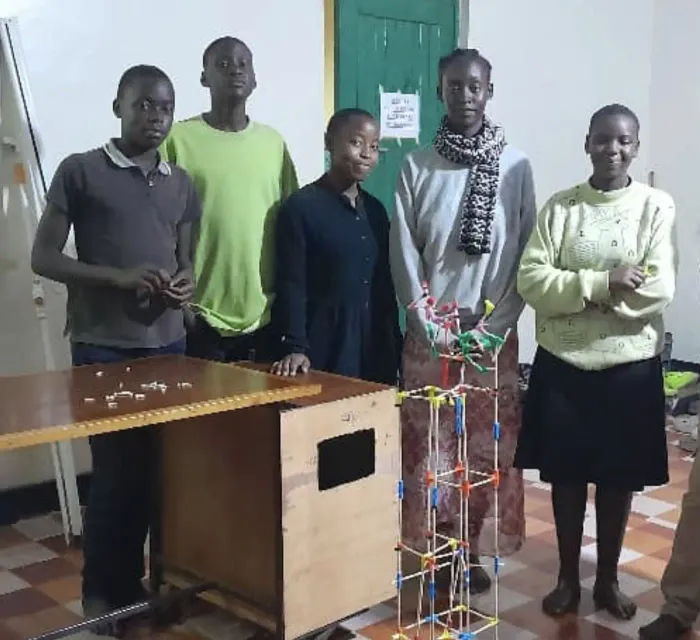
Kigezi High School sits about four hundred kilometres from Kampala. One teacher there was trained remotely, and with the kit and the online lesson materials the school set up its own coding and robotics club and ran it themselves.
Half a year later the teacher wrote to say the school had ranked first in the country. Nobody from Stick ’Em was in the room for any of it.
That is the design goal stated as plainly as we can state it. A programme that only works while we are standing in it is not a programme, it is a visit.
Where it runs
Twenty-two countries, and the range is the point.
Top schools in Singapore and a stilt-house school for stateless children in Sabah run the same kit, the same lesson materials and the same three-hour workshop. Nothing changes between them, which is the entire argument for building it this cheaply.
35,000+ students and 3800+ teachers, across 22 countries.
Evidence, honestly
What we can prove, and what we cannot.
What the data shows
- 4.67 out of 5 overall from 658 teachers on the Level 2 professional development feedback, with 97 percent rating it four or five.
- Twenty-nine percent of those teachers asked for a Classroom Set for their own classroom, unprompted, on the feedback form.
- Teacher-reported confidence to run a session without a specialist present, which is the mechanism the whole model depends on.
- Adoption at national scale in Brunei, and about one in five schools in Singapore.
What does not exist yet
- There is no independent controlled study of learning outcomes. Nobody has run one, including us.
- So we have satisfaction and readiness data, not measured attainment gains, and we will not present one as the other.
- If your process needs an evidence tier, tell us which framework and we will tell you exactly where we sit against it rather than guessing upward.
- Commissioning proper efficacy research is the thing we most want a funding partner for.
Curriculum fit
Mapping to your framework is our work, not yours.
Lessons are built around Singapore’s 21st Century Competencies framework and mapped across more than a hundred national frameworks. In the Philippines we mapped 110 Academy lessons to DepEd’s MATATAG curriculum line by line.
If your framework is not covered, that is a piece of work we do at the start of a partnership. A teacher should be able to search for the topic they are already required to teach and find the lesson, rather than being asked to justify why a robot belongs in a geography period.





How a programme starts
Nobody signs a national rollout first.
A workshop that costs nothing
We run one session for your teachers, usually at no cost. It is the cheapest way for both sides to find out whether this is real.
A pilot in a handful of schools
A cluster, a term, real lessons. Enough to see what happens in your classrooms rather than in our photographs.
Train your trainers
Your own people learn to run the workshop. From here the programme stops depending on us being in the country.
Scale on your terms
Phased or whole-system. Brunei went from a workshop tour to a national costing inside one academic year.
From ministries, teacher educators and classrooms
What the people inside the system say
“For educators looking for practical, easy to implement STEAM activities that are accessible for all learners, Stick ’Em can provide valuable strategies to develop an engaging and inclusive lesson.”
“We are moving beyond traditional learning to give students and teachers the power to be designers of the future. We shift the focus from simply following instructions to solving real-world problems.”
“Stick ’Em has helped make STEAM education more affordable and accessible to tens of thousands of students.”
“It is an equalizer for schools, whereby children from different places with different background can use the same kit to create magic!”
“Bringing Stick ’Em activities into classroom teaching can effectively demonstrate abstract knowledge, boost students’ learning engagement and stimulate their creative thinking.”
“Hands-on experience suited better for the non-academic achiever!”
“Everyone is actually ready. It is a matter of when to start before future comes.”
“The workshop introduces you to 21st century skills which the new generation need.”
Questions ministries ask
For ministries and funders
Pricing and buying
Start with a conversation, not a proposal.
Tell us the country, roughly how many schools, and what has to be true for this to pass your process. We will tell you what we can do and what we cannot.